The Dallas Builders Club Blog
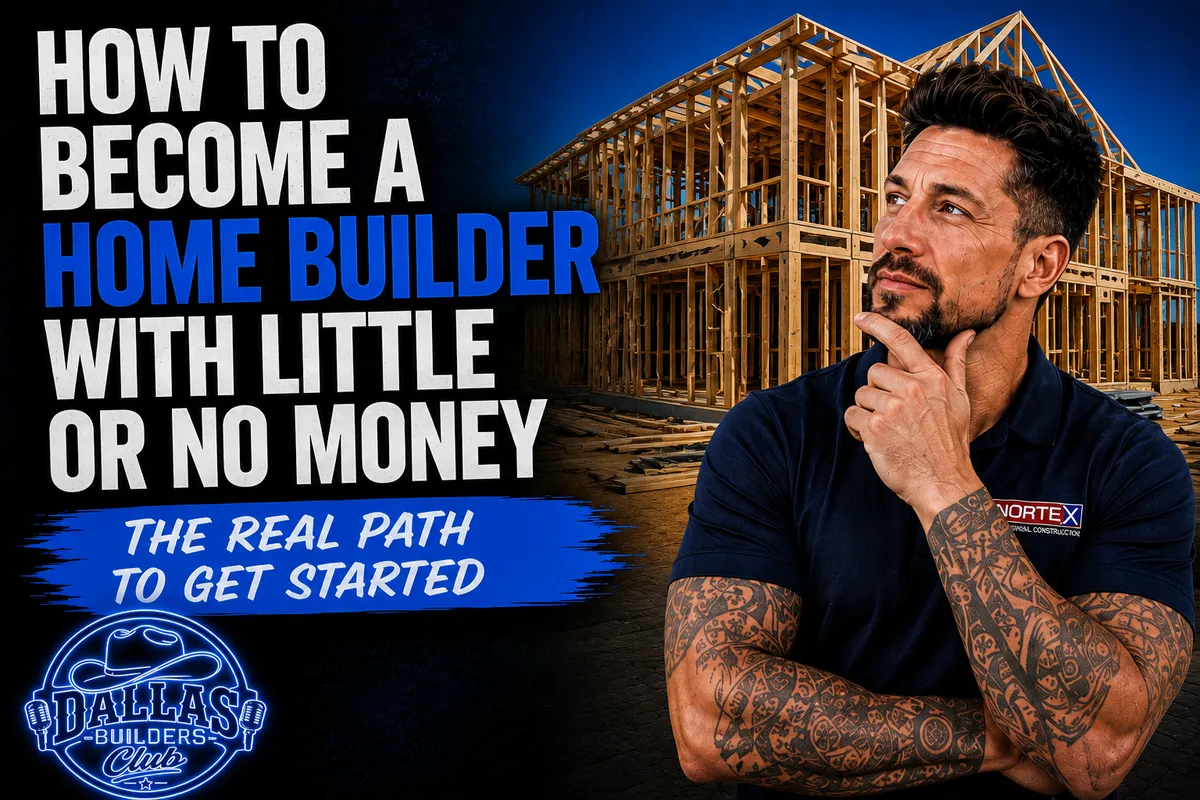
How to Become a Home Builder With No Money
How Do You Become a Home Builder If You Don't Have Money?
This was one of the most common questions we heard at our first Dallas Builders Club Meet & Greet:
“I want to get into home building and real estate development, but I don't have the money. What do I do?”
There's no magic answer.
Building homes requires capital.
Land costs money. Plans cost money. Engineering costs money. Permits cost money. Construction obviously costs money.
But that doesn't necessarily mean all of that money has to be yours.
If you're trying to figure out how to become a home builder with no money, you need to understand something first: your most valuable starting point may not be capital. It may be knowledge, relationships, and your ability to create value.
Stop Starting With the Money
A lot of new real estate investors approach the business backward.
They think:
“I need $500,000 before I can become a developer.”
Instead, start asking yourself:
Can I identify a good real estate deal?
Can I underwrite it?
Can I estimate construction costs?
Can I determine the likely sales price?
Can I understand the risks?
Can I create a realistic project timeline?
Can I explain the opportunity to someone else?
If you can't do those things, raising money isn't your biggest problem.
Even if someone handed you the capital tomorrow, you wouldn't necessarily know what to do with it.
Before trying to raise money for your first home building project, focus on learning how real estate development works, how builders evaluate opportunities, and what makes a deal financially viable.
Learn How to Underwrite Real Estate Deals
Before worrying about investors, learn how to determine whether an opportunity actually makes financial sense.
Suppose you find a lot.
What can you build?
What's the land cost?
What's the construction cost?
What are your financing expenses?
What's the anticipated finished value?
What are your selling costs?
What's your contingency?
How much profit remains after all expenses?
These are the kinds of questions a real estate developer needs to answer before committing to a project.
Now you're no longer saying:
“I want to build houses. Will you give me money?”
You're saying:
“I've identified a property at this price. We can build this product for approximately this amount. Comparable properties support this exit value. Here are the financing costs, timeline, risks, and projected return.”
That's a completely different conversation.
Learning real estate deal analysis and construction budgeting helps you demonstrate that you understand the opportunity before asking someone else to invest in it.
Real Estate Investors Need Capable Operators
There are people with capital who don't want another job.
They don't want to meet subcontractors.
They don't want to visit job sites.
They don't want to manage schedules.
They don't want to learn construction.
They want opportunities.
If you can become the person capable of finding and executing those opportunities, you have value.
That's where sweat equity becomes important.
Maybe an investor provides capital while you provide the opportunity and execution. There are countless ways real estate investment deals can be structured, depending on the project, the people involved, and the responsibilities each person takes on.
The important point is that a lack of personal capital doesn't automatically eliminate you from the business.
Lack of knowledge, relationships, and execution ability is much harder to overcome.
If you're exploring how to become a real estate developer without substantial personal savings, focus on building skills that make you a valuable partner. Learn how to evaluate land, understand construction budgets, identify potential risks, and communicate a project's financial potential.
Remember, finding an investor is not a substitute for knowing how to execute a deal.
If I Had Nothing, I'd Go Work for Someone
If you dropped me into a completely new city tomorrow with no money, no contacts, and no reputation, one of my first moves would be simple:
I'd find the best person doing what I wanted to do and go work for them.
I'd learn how they operate.
I'd meet their trades.
I'd understand their systems.
I'd watch how they find deals.
I'd learn how they interact with investors.
I'd study how they price projects.
I'd watch what they do when things go wrong.
Instead of spending years trying to figure everything out myself, I'd get paid to learn inside an operating business.
That's essentially what I did when I wanted to transition further into building.
For someone interested in becoming a home builder, working alongside an experienced builder can offer valuable exposure to construction management, subcontractor relationships, project scheduling, budgeting, and the day-to-day realities of residential construction.
You may not be ready to run your own development company yet. That doesn't mean you can't start learning the business today.
Make Yourself Impossible to Ignore
Don't send one email to a successful builder and quit when they don't respond.
Successful people are busy.
Find a way to provide value.
Ask to shadow them.
Offer to work.
Help on jobsites.
Take notes during walks.
Organize information.
Do something useful.
You may not have capital, but you have time and effort.
Use them.
Building relationships with experienced home builders and real estate developers takes initiative. You have to demonstrate that you're serious, willing to learn, and capable of following through.
Don't approach every relationship by asking what someone can do for you. Look for opportunities to make their work easier, solve a problem, or contribute something meaningful.
Over time, that effort can help you develop the experience and credibility needed to pursue your own real estate investment opportunities.
Then Start Building Your Real Estate Network
As your knowledge grows, start putting yourself around people involved in real estate deals.
Builders.
Developers.
Real estate investors.
Lenders.
Title companies.
Architects.
Realtors.
Business owners.
These relationships can help you better understand how projects come together, how capital is sourced, and what different partners contribute to a successful development.
For aspiring builders in Dallas-Fort Worth, getting involved in the local real estate community can also help you learn about the people, processes, and opportunities shaping the DFW market.
Attend industry events. Ask thoughtful questions. Learn from experienced operators. Build relationships before you need something from them.
Your network won't replace your knowledge, but the right relationships can help you put that knowledge to work.
Start Building Value Before You Have Capital
You don't necessarily need to start your home building journey with hundreds of thousands of dollars in the bank.
You do need to understand the business you're trying to enter.
Learn how to analyze real estate deals. Understand construction costs. Develop relationships with experienced builders. Learn how financing works. Find ways to contribute value to an existing business.
Then, when a potential opportunity comes along, you'll be better prepared to evaluate it, explain it, and determine whether it's worth pursuing.
At Dallas Builders Club, we believe that learning how the building process actually works is an important step toward becoming a capable builder and real estate developer.
You don't have to know everything on day one. But you do have to be willing to learn, take action, and develop the skills that make you a valuable part of a project.
Because the goal isn't simply to find someone willing to give you money.
It's to become someone who knows what to do with the opportunity.
If you want to become a home builder but don't have the money yet, start by building the knowledge, experience, and relationships that can help you get there.